


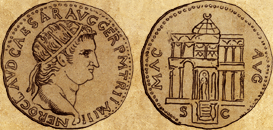
Merchants and bankers probably spent some of their time in the Forum, the central market place, and the Basilica where council decisions and legal cases were heard and decisions made, like the Town Hall and Law Courts today. Big business deals would have needed gold and silver coins but Londoners mainly used bronze coins for shopping. Each coin was minted with a picture of the emperor on one side ('heads') and a design, perhaps of a god or goddess or celebrating a victory in an important battle or the opening of an important building, on the reverse ('tails'). Each side had an inscription running around the outside edge. On the head side would be the formal names of the emperor, very similar to our coinage today where the Queen's name is given.
Most Londoners would have had a basic knowledge of Latin, the language used by the Romans. Everyone needed to keep accounts, send letters or have copies of business contracts. They often used wooden writing tablets that had a layer of beeswax. The wax on the tablet rarely survives but the pointed implement (stylus) which was used to write on wax sometimes pressed into the wood below, leaving us with the scratched letters. One contract is about a young slave girl from France, called Fortunata ('Lucky'), who was sold at a local slave market and who was bought by another slave who worked in the government treasury.


